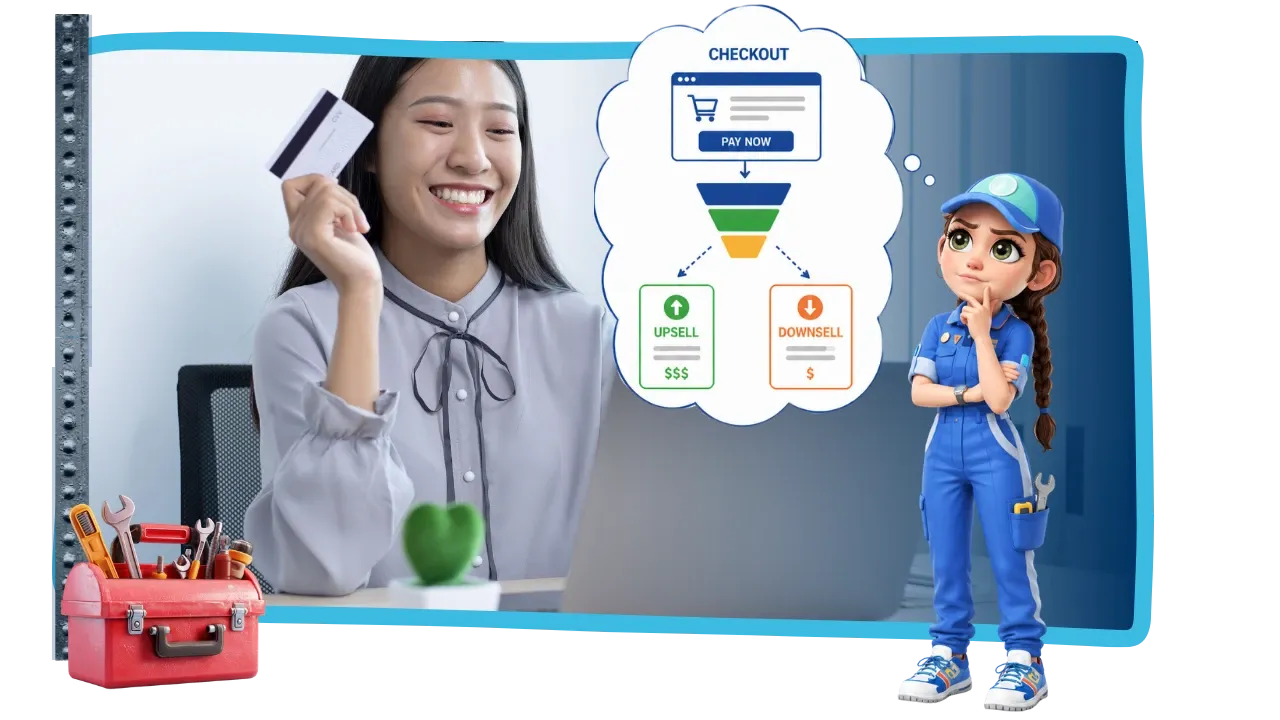
RENEWED FEATURE Upsells and Downsells in Kajabi ...They’re Not Just Sales Tools
They reveal how well your entire offer ecosystem actually works
Kajabi works best when you stop thinking of it as a collection of products. It works best when you treat it as an ecosystem.
Your Kajabi machine.
Kajabi machine is an ecosystem where each offer has a clear role.
Where every step supports the next.
Where the buyer always understands where they are, what they should do next, and why it matters.
That is why upsells and downsells are strategically so interesting.
Not because they increase revenue. (Although they absolutely can.)
But because they actually expose the logic behind your business.
When they work well, the next step feels obvious and very natural.
The buyer barely has to think, momentum builds and continues naturally.
When they do NOT work well, friction becomes visible immediately.
Suddenly the buyer has to pause for too long and starts to question relevance. They’re trying to understand why this offer is appearing and how it connects with what they just bought.
And that moment matters more than most business owners realize. Because the upsell and downsell moment happens at a very specific and surprisingly powerful stage of the buyer journey.
The original purchase is already complete.
Trust is at its highest. Momentum is active. The process is frictionless.
There is no need to re-enter payment details or to restart the decision process. No risk of losing the original sale.
That combination exists almost nowhere else in your funnel.
Every other placement carries risk.
A sales page can overwhelm.
An email can interrupt.
A social post can distract.
But here?
The buyer is already moving.
Which means your upsell or downsell becomes something much bigger than an additional offer. It becomes a reflection of how intentionally your ecosystem was designed.

A Good Upsell Does Not Start a New Sales Process
The role of an upsell is not to suddenly introduce a completely different direction. It is to reinforce certainty.
“You’re on the right path.
This is the next thing that will help you continue.”
That is what a strong upsell feels like.
It confirms that the original purchase was a good decision and it extends that momentum forward.
This is also why clarity matters so much.
A confusing upsell creates hesitation.
A specific upsell creates confidence.
The buyer should immediately understand (without too much thinking):
- why this is being offered
- why it matters now
- how it connects to what they just purchased
The more precisely the upsell relates to the decision they already made, the less it feels like selling and the more it feels like guidance. And that distinction matters.
Especially in knowledge businesses.
You build your Kajabi machine around trust, education, transformation, or long-term client relationships.
But you need to remember, that confidence is surprisingly fragile after purchase. A buyer can be excited and uncertain at the exact same time. You want to be smart planning this.
A strong upsell works hard:
It reassures the buyer and makes the next step feel easier to step into.
It reduces decision fatigue and reinforces momentum.
It helps the buyer feel smart for taking action.
And psychologically, that matters more than most people think.
People like feeling that they made a good decision.
A well-positioned upsell reinforces that identity.
Not through pressure. Through relevance.
The Biggest Upsell Mistakes
The most common mistake is NOT bad copy or lack of urgency. It is misalignment.
Business owners often treat upsells as an opportunity to place another offer nearby. But proximity is not strategy.
Just because two offers can technically sit next to each other inside Kajabi does not mean they belong together.
An upsell should deepen the same transformation.
Not suddenly introduce a new audience, new goal, or completely different problem.
A buyer should never have to mentally switch tracks immediately after purchasing.
That is where things start feeling thrown together instead of intentionally built.
For example:
Someone buys a foundational course.
Then immediately gets pitched a completely unrelated coaching offer at ten times the price.
Technically? Yes, it is an upsell.
Strategically? It often creates disconnect.

The buyer has not even had time to orient themselves inside the original purchase yet.
And this is where pricing proximity matters too.
If someone just bought a smaller product, an extremely high-ticket offer immediately afterward can feel emotionally jarring unless the relationship between the two offers is exceptionally clear.
The buyer should feel progression. Not whiplash.
A good rule of thumb:
The upsell should feel like a natural extension of the original decision, not a completely separate leap.
If the next thing they see after the initial purchase feels opportunistic, disconnected, or overwhelming, also the trust starts leaking immediately. Like a flattening tire...
This is one of the reasons badly designed upsells damage businesses quietly.
Not usually wityh a huge drame, but quietly in the customers head and hearts.
The buyer may still complete the purchase, but something about the interaction starts feeling heavier. More transactional and far less supportive.

The Decline Experience Matters More Than People Realize
How someone says “no” to your upsell matters too. A lot.
The decline experience is part of the customer experience. If declining feels manipulative, guilt-heavy, passive aggressive, or intentionally difficult, trust erodes fast.
The “No thanks” option should feel completely safe.
No pressure.
No shame.
No emotional manipulation.
Because how a buyer is treated when they decline tells them just as much about your business as how they are treated when they say yes.
And honestly? People remember that feeling.

Downsells Are Not Desperation Tools
Most Kajabi business owners either skip downsells entirely or treat them as discount tools. Neither approach is particularly useful. A strong downsell is not a cheaper version of the same thing.
And it definitely should not feel like: “Oh wait, actually… here’s the discount version.”
That kind of positioning can weaken trust in the original offer very quickly.
A great downsell does something much smarter. It is a different path toward the same outcome.
But the pace, commitment, complexity, timing, support level, or format changes.
It respects where the buyer is right now.
That is why I often think of downsells as listening tools. When someone declines an upsell, they are communicating something:
Maybe the timing feels wrong.
Maybe the price feels too large.
Maybe the support level feels too intensive.
Maybe they simply need a smaller entry point.
A good downsell responds to that information thoughtfully and supportively.
Not defensively or showing desperation.
But intelligently.
It says: “I understand. Here’s another way forward.”
And when done well, that flexibility you showed your customer strengthens trust instead of weakening it. Because they feel understood instead of cornered or dismissed.
Upsells and Downsells Are Positioning Tools
This is the part people rarely talk about.
Your upsells and downsells communicate how your business thinks.
They reveal:
💠 How well you understand your buyer.
💠 How intentionally your ecosystem was designed.
💠 Whether your offers actually support each other.
💠 Whether you understand what the client needs next.
A thoughtful upsell positions you as someone who has considered the entire client experience.
Not just the transaction.
It signals: “I already thought about what comes after this.”
That kind of anticipatory clarity builds enormous trust.
Poorly connected offers communicate the opposite.
They make the ecosystem feel stitched together.
And buyers feel that (even if they cannot articulate it directly).
A coherent upsell builds trust. An incoherent one quietly spends it.
What could possibly go wrong 😁...

There is also a point where adding more offers starts hurting the system. More is not automatically better.
Too many post-purchase offers create noise.
Not opportunity.
Every upsell creates:
💠A new expectation
💠A new micro experience
💠 A new decision (try to keep this as easy
and effortless as possible)
💠 A new opportunity for friction (Yikes!)
Which means one poorly designed step can affect the emotional experience of the entire purchase.
This becomes especially important in education-based businesses.
Because course businesses, memberships, coaching programs, and service ecosystems are not only measured by immediate sales.
They are measured by:
- Usage
- Completion
- Engagement
- Retention
- Relationship depth
- Client success
If the original offer is already overwhelming, adding more on top can actually make the experience worse. You are seen monetizing confusion instead of resolving it. And short-term revenue can easily hide long-term retention problems.
That is why I do not believe upsells should be added automatically. Sometimes the right strategic decision is not adding another offer.
As a well-thought-out part of the SYSTEM, they could be fantastic!
So, when NOT to Use Upsells or Downsells
Do not add them just because Kajabi makes them now so easy to implement.
Avoid them when:
💠the main offer is still unclear
💠 the buyer is already overloaded with decisions
💠 the hesitation is really about trust or positioning
💠 you are trying to compensate for a deeper structural problem
💠 the original offer itself is not functioning properly yet
If you are using additional offers to patch confusion, you are already too late.
Because no upsell fixes a weakly planned ecosystem.
It only exposes it faster.

Questions Worth Asking Yourself
Before Adding Upsells and/or Downsells
About the upsell
🔵 Does this continue the same transformation or start a completely new one?
🔵 What is the single most useful thing I could add to the buyer’s experience right now?
🔵 Does this reduce friction or create more complexity?
🔵 Does this increase clarity, confidence, and momentum?
🔵 Does the value feel immediately obvious at this price point?
About the downsell
🔵 What hesitation am I actually responding to?
🔵 Is this solving for budget, timing, support level, commitment, or delivery style?
🔵 Does this still feel like a complete and valuable offer?
🔵 Could someone naturally progress toward the primary offer later?
About the ecosystem itself
🔵Do these offers together tell a coherent story?
🔵Would the buyer feel guided or sold to?
🔵Does this sequence strengthen the client experience or fragment it?
When the Strategy Is Well Thought Through
Used deliberately, upsells and downsells become much more than revenue tools. They reveal the quality of thinking behind your business.
The UPSELL shows whether you understand what your buyer needs next.
The DOWNSELL shows whether you understand why they might hesitate. And do you value these clients as much as people buying the main offer.
And together?
They transform a checkout from a transaction endpoint into part of the relationship itself.
When done well, the buyer leaves feeling understood and well cared for. Not pressured.
And honestly, that difference is usually what separates a business that merely sells offers from one that builds a genuinely strong ecosystem.

WANT TO GET GRANULAR?
Strategic Upsells and Downsells for Different Kajabi Products
Sign in to read the extended version of this blog post.
With the same sign in you'll be able to step into the workshed and receive (admittedly irregular 😁) Email News straight to your inbox.
If you're already a regular at the workshed, just log in to continue reading 😉👌.
In the extended version reserved for the workshed insiders, I go deeper into how upsells and downsells work across different types of Kajabi products.
We'll dig a bit deeper at:
- how to tell two offers genuinely belong together
- what makes a downsell feel supportive instead of reactive
- strategic approaches for courses, memberships, communities, coaching programs, services and hybrid offers
- when a separate upsell creates clarity — and when it only creates more friction
- the structural mistakes that quietly weaken buyer experience
- how upsell performance can reveal deeper ecosystem issues
Plus practical examples for different kinds of Kajabi product use
...Ready to go a little deeper?
Inside the Workshed Deep Dive (the extended version of this blog post),
you’ll find deeper strategy, practical examples, and more detailed breakdowns connected to the topic.
Register as a workshed insider to continue reading.
Already inside the workshed? Log in here.